
. . . And How We Can Use It to Build a Safer, More Prevention-Focused Future
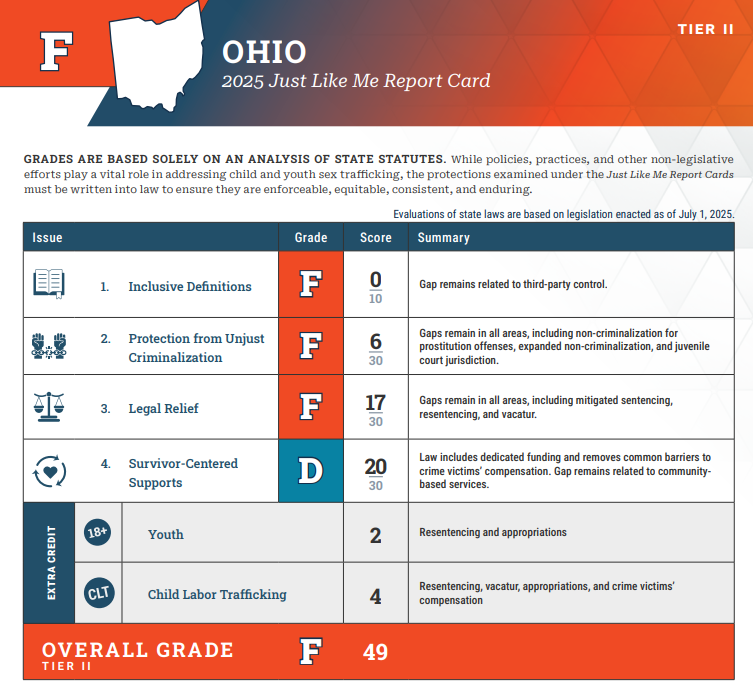
Every few years, Shared Hope International releases a Report Card evaluating how well states protect children who have been commercially sexually exploited. The Report Card framework is shaped by feedback from survivors, service providers, and field-informed research, ensuring policy priorities reflect real-world impacts and survivor needs. The Report Card looks at questions that matter deeply to all of us:
-
- Are children identified early?
- Are they protected—not punished—when exploitation is disclosed?
- Are trauma-informed services accessible?
- And do state laws support these protections?
This year, Ohio received a failing grade. That headline can feel discouraging. But the grade tells only part of the story. What matters most is why it happened, what it reflects, and how it can guide Ohio’s next steps toward prevention and safety.
At the Collaborative, we view the Report Card not as a judgment, but as a tool—one that helps us understand where our legal framework supports children and where critical gaps remain.
View report cards for all states.
Why Shared Hope Raised the Bar
In 2022, Shared Hope updated its entire evaluation model. Instead of scoring states on a narrow set of trafficking laws, the new model examines ten policy goals across four key areas:
- How states define and identify child sex trafficking victims
- Whether children are protected from unjust criminalization
- Whether survivors have meaningful opportunities for record clearing or resentencing
- Whether children can access specialized, trauma-informed services
These updates reflect the lived experience of survivors and the insights of frontline providers. They also set a much higher standard for all states—including Ohio.
A lower grade today does not mean states are doing less. It means expectations have become more survivor-centered, and the bar for child protection has risen.
What Ohio’s 2025 Grade Really Means
Ohio received an F, joining 31 other states. This score is based exclusively on existing state statutes. It does not capture the daily work unfolding across communities, agencies, and coalitions like ours. Shared Hope’s evaluation highlights several areas where Ohio’s laws fall short under the updated model:
1. Not all exploited children are recognized as victims
— Children exploited directly by buyers—without a third-party trafficker—are not clearly protected under Ohio law.
2. Minors can still be charged with prostitution-related offenses
— While diversion programs exist, youth must comply with court-ordered conditions that can feel punitive and retraumatizing.
3. No protections for crimes linked to victimization
— Children may still be charged with offenses—status offenses, misdemeanors, and even felonies—that often stem from coercion and survival strategies.
4. Mandatory minimums still apply to minors
— Judges cannot depart from mandatory minimum sentences even when a child’s exploitation directly contributes to the offense.
5. Record clearing and resentencing options are limited
— Many survivors continue to face long-term consequences for convictions connected to their exploitation.
6. Specialized services are often tied to system involvement
— In many communities, youth cannot access trafficking-specific services unless they enter child welfare or juvenile justice systems. Families deserve voluntary, community-rooted pathways instead.
These gaps show that Ohio’s legal framework lags behind what children need for protection, healing, and safety.
Where Ohio Is Making Meaningful Progress
Despite these challenges, Ohio has made significant strides that reflect statewide commitment and momentum. Ohio has:
-
- Maintained funding Ohio maintained a dedicated state budget line item for anti-trafficking services, and this year that funding supported organizations within Greater Cleveland’s Coordinated Response to Human Trafficking— including Asian Services in Action, Bellefaire JCB, Cleveland Rape Crisis Center, Freedom a la Cart, Gracehaven, Harriet Tubman Movement, MetroHealth, and RAHAB Ministries— to expand their programming for survivors.
- Improved access to crime victims’ compensation for minors.
- Strengthened trauma-informed practices in child-serving systems.
- Seen local innovation across schools, healthcare, social services, and regional task forces.
These bright spots matter. They demonstrate that Ohio is not standing still—communities are building solutions every day.
How the Findings Connect to Prevention
The most powerful lesson from the Report Card is its reinforcement of a truth we see across the state: prevention must begin long before exploitation occurs.
When a child can be charged with offenses tied to their own victimization, the system is responding far too late. And when services are available only through formal system involvement, families can feel punished for seeking help.
Upstream prevention requires strengthening the conditions that allow children to thrive:
-
- Stable housing
- Strong school connections
- Accessible behavioral health care
- Trusted relationships with caring adults
- Safe and affirming community spaces
These protective factors reduce vulnerability long before a trafficker enters a child’s life. The Shared Hope findings underscore why prevention is not optional—it is foundational.
Opportunities to Move Ohio Forward
Ohio has clear opportunities to modernize its legal framework and better protect children. Key changes include:
-
- Mandate child trafficking prevention education in schools.
- Require child welfare agencies to screen system-involved youth for trafficking risk.
- Prohibit the criminalization of minors for prostitution-related offenses.
- Mandate ongoing trafficking-specific, victim-centered training for law enforcement and prosecutors
- Require that all sex trafficking victims have access to a victim advocate.
These reforms would not only strengthen legal protections—they would help build a more prevention-oriented, healing-centered system across Ohio.
Moving Forward Together
Across the state, dedicated partners are supporting survivors, educating communities, strengthening safety nets, and advocating for smarter policy. Their expertise, commitment, and lived experience shape better solutions every day.